Analog Circuits
Discharging capacitor
Shows how to connect to a switch with anchors.
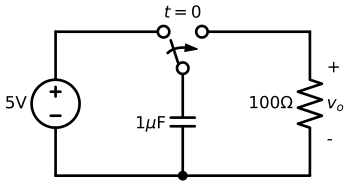
with schemdraw.Drawing() as d:
    d += (V1 := elm.SourceV().label('5V'))
    d += elm.Line().right(d.unit*.75)
    d += (S1 := elm.SwitchSpdt2(action='close').up().anchor('b').label('$t=0$', loc='rgt'))
    d += elm.Line().right(d.unit*.75).at(S1.c)
    d += elm.Resistor().down().label('$100\Omega$').label(['+','$v_o$','-'], loc='bot')
    d += elm.Line().to(V1.start)
    d += elm.Capacitor().at(S1.a).toy(V1.start).label('1$\mu$F').dot()
Capacitor Network
Shows how to use endpoints to specify exact start and end placement.
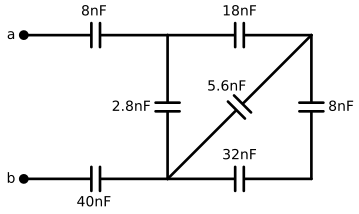
with schemdraw.Drawing() as d:
    d.config(fontsize=12)
    d += (C1 := elm.Capacitor().label('8nF').idot().label('a', 'left'))
    d += (C2 := elm.Capacitor().label('18nF'))
    d += (C3 := elm.Capacitor().down().label('8nF', loc='bottom'))
    d += (C4 := elm.Capacitor().left().label('32nF'))
    d += (C5 := elm.Capacitor().label('40nF', loc='bottom').dot().label('b', 'left'))
    d += (C6 := elm.Capacitor().endpoints(C1.end, C5.start).label('2.8nF'))
    d += (C7 := elm.Capacitor().endpoints(C2.end, C5.start)
          .label('5.6nF', loc='center', ofst=(-.3, -.1), halign='right', valign='bottom'))
ECE201-Style Circuit
This example demonstrate use of push() and pop() and using the ‘tox’ and ‘toy’ methods.
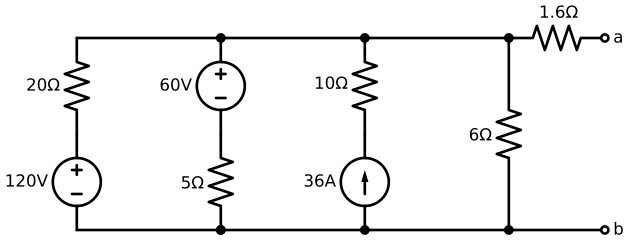
with schemdraw.Drawing() as d:
    d.config(unit=2)  # unit=2 makes elements have shorter than normal leads
    d.push()
    d += (R1 := elm.Resistor().down().label('20Ω'))
    d += (V1 := elm.SourceV().down().reverse().label('120V'))
    d += elm.Line().right(3).dot()
    d.pop()
    d += elm.Line().right(3).dot()
    d += elm.SourceV().down().reverse().label('60V')
    d += elm.Resistor().label('5Ω').dot()
    d += elm.Line().right(3).dot()
    d += elm.SourceI().up().label('36A')
    d += elm.Resistor().label('10Ω').dot()
    d += elm.Line().left(3).hold()
    d += elm.Line().right(3).dot()
    d += (R6 := elm.Resistor().toy(V1.end).label('6Ω').dot())
    d += elm.Line().left(3).hold()
    d += elm.Resistor().right().at(R6.start).label('1.6Ω').dot(open=True).label('a', 'right')
    d += elm.Line().right().at(R6.end).dot(open=True).label('b', 'right')
Loop Currents
Using the schemdraw.elements.lines.LoopCurrent element to add loop currents, and rotating a label to make it fit.

with schemdraw.Drawing() as d:
    d.config(unit=5)
    d += (V1 := elm.SourceV().label('20V'))
    d += (R1 := elm.Resistor().right().label('400Ω'))
    d += elm.Dot()
    d.push()
    d += (R2 := elm.Resistor().down().label('100Ω', loc='bot', rotate=True))
    d += elm.Dot()
    d.pop()
    d += (L1 := elm.Line())
    d += (I1 := elm.SourceI().down().label('1A', loc='bot'))
    d += (L2 := elm.Line().tox(V1.start))
    d += elm.LoopCurrent([R1,R2,L2,V1], pad=1.25).label('$I_1$')
    d += elm.LoopCurrent([R1,I1,L2,R2], pad=1.25).label('$I_2$')    # Use R1 as top element for both so they get the same height
AC Loop Analysis
Another good problem for ECE students…

with schemdraw.Drawing() as d:
    d += (I1 := elm.SourceI().label('5∠0° A').dot())
    d.push()
    d += elm.Capacitor().right().label('-j3Ω').dot()
    d += elm.Inductor().down().label('j2Ω').dot().hold()
    d += elm.Resistor().right().label('5Ω').dot()
    d += (V1 := elm.SourceV().down().reverse().label('5∠-90° V', loc='bot'))
    d += elm.Line().tox(I1.start)
    d.pop()
    d += elm.Line().up(d.unit*.8)
    d += (L1 := elm.Inductor().tox(V1.start).label('j3Ω'))
    d += elm.Line().down(d.unit*.8)
    d += elm.CurrentLabel(top=False, ofst=.3).at(L1).label('$i_g$')
Infinite Transmission Line
Elements can be added inside for-loops if you need multiples.
The ellipsis is just another circuit element, called DotDotDot since Ellipsis is a reserved keyword in Python.
This also demonstrates the schemdraw.elements.ElementDrawing class to merge multiple elements into a single definition.

with schemdraw.Drawing(show=False) as d1:
    d1 += elm.Resistor()
    d1.push()
    d1 += elm.Capacitor().down()
    d1 += elm.Line().left()
    d1.pop()

with schemdraw.Drawing() as d2:
    for i in range(3):
        d2 += elm.ElementDrawing(d1)

    d2.push()
    d2 += elm.Line().length(d2.unit/6)
    d2 += elm.DotDotDot()
    d2 += elm.ElementDrawing(d1)
    d2.pop()
    d2.here = (d2.here[0], d2.here[1]-d2.unit)
    d2 += elm.Line().right().length(d2.unit/6)
    d2 += elm.DotDotDot()
Power supply
Notice the diodes could be added individually, but here the built-in Rectifier element is used instead. Also note the use of newline characters inside resistor and capacitor labels.
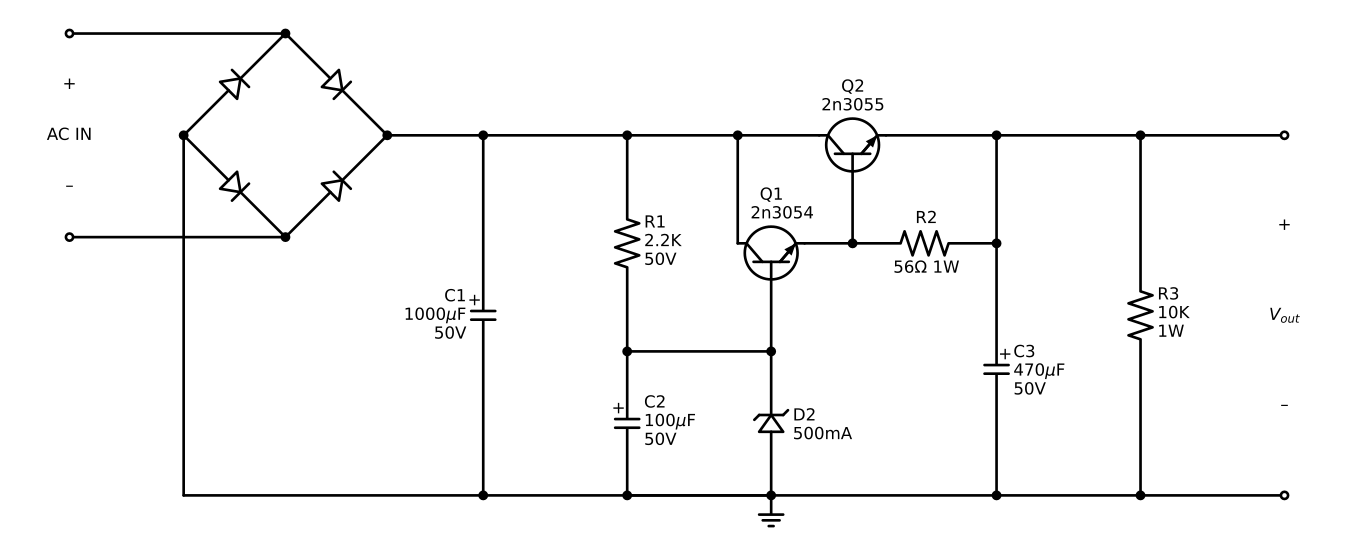
with schemdraw.Drawing() as d:
    d.config(inches_per_unit=.5, unit=3)
    d += (D := elm.Rectifier())
    d += elm.Line().left(d.unit*1.5).at(D.N).dot(open=True).idot()
    d += elm.Line().left(d.unit*1.5).at(D.S).dot(open=True).idot()
    d += (G := elm.Gap().toy(D.N).label(['–', 'AC IN', '+']))

    d += (top := elm.Line().right(d.unit*3).at(D.E).idot())
    d += (Q2 := elm.BjtNpn(circle=True).up().anchor('collector').label('Q2\n2n3055'))
    d += elm.Line().down(d.unit/2).at(Q2.base)
    d += (Q2b := elm.Dot())
    d += elm.Line().left(d.unit/3)
    d += (Q1 := elm.BjtNpn(circle=True).up().anchor('emitter').label('Q1\n    2n3054'))
    d += elm.Line().at(Q1.collector).toy(top.center).dot()

    d += elm.Line().down(d.unit/2).at(Q1.base).dot()
    d += elm.Zener().down().reverse().label('D2\n500mA', loc='bot').dot()
    d += (G := elm.Ground())
    d += elm.Line().left().dot()
    d += elm.Capacitor(polar=True).up().reverse().label('C2\n100$\mu$F\n50V', loc='bot').dot()
    d += elm.Line().right().hold()
    d += elm.Resistor().toy(top.end).label('R1\n2.2K\n50V', loc='bot').dot()

    d.move(dx=-d.unit, dy=0)
    d += elm.Capacitor(polar=True).toy(G.start).flip().label('C1\n 1000$\mu$F\n50V').dot().idot()
    d += elm.Line().at(G.start).tox(D.W)
    d += elm.Line().toy(D.W).dot()

    d += elm.Resistor().right().at(Q2b.center).label('R2').label('56$\Omega$ 1W', loc='bot').dot()
    d.push()
    d += elm.Line().toy(top.start).dot()
    d += elm.Line().tox(Q2.emitter)
    d.pop()
    d += elm.Capacitor(polar=True).toy(G.start).label('C3\n470$\mu$F\n50V', loc='bot').dot()
    d += elm.Line().tox(G.start).hold()
    d += elm.Line().right().dot()
    d += elm.Resistor().toy(top.center).label('R3\n10K\n1W', loc='bot').dot()
    d += elm.Line().left().hold()
    d += elm.Line().right()
    d += elm.Dot(open=True)
    d += elm.Gap().toy(G.start).label(['+', '$V_{out}$', '–'])
    d += elm.Dot(open=True)
    d += elm.Line().left()
5-transistor Operational Transconductance Amplifer (OTA)
Note the use of current labels to show the bias currents.

with schemdraw.Drawing() as d:
    # tail transistor
    d += (Q1 := elm.AnalogNFet()).anchor('source').theta(0).reverse()
    d += elm.Line().down().length(0.5)
    ground = d.here
    d += elm.Ground()

    # input pair
    d += elm.Line().left().length(1).at(Q1.drain)
    d += (Q2 := elm.AnalogNFet()).anchor('source').theta(0).reverse()

    d += elm.Dot().at(Q1.drain)
    d += elm.Line().right().length(1)
    d += (Q3 := elm.AnalogNFet()).anchor('source').theta(0)

    # current mirror
    d += (Q4 := elm.AnalogPFet()).anchor('drain').at(Q2.drain).theta(0)
    d += (Q5 := elm.AnalogPFet()).anchor('drain').at(Q3.drain).theta(0).reverse()

    d += elm.Line().right().at(Q4.gate).to(Q5.gate)

    d += elm.Dot().at(0.5*(Q4.gate + Q5.gate))
    d += elm.Line().down().toy(Q4.drain)
    d += elm.Line().left().tox(Q4.drain)
    d += elm.Dot()

    # vcc connection
    d += elm.Line().right().at(Q4.source).to(Q5.source)
    d += elm.Dot().at(0.5*(Q4.source + Q5.source))
    d += elm.Vdd()

    # bias source
    d += elm.Line().left().length(0.25).at(Q1.gate)
    d += elm.SourceV().down().toy(ground).reverse().scale(0.5).label("Bias")
    d += elm.Ground()

    # signal labels
    d += elm.Tag().at(Q2.gate).label("In+").left()
    d += elm.Tag().at(Q3.gate).label("In−").right()
    d += elm.Dot().at(Q3.drain)
    d += elm.Line().right().tox(Q3.gate)
    d += elm.Tag().right().label("Out").reverse()

    # bias currents
    d += elm.CurrentLabel(length=1.25, ofst=0.25).at(Q1).label("20µA")
    d += elm.CurrentLabel(length=1.25, ofst=0.25).at(Q4).label("10µA")
    d += elm.CurrentLabel(length=1.25, ofst=0.25).at(Q5).label("10µA")
Quadruple loop negative feedback amplifier

with schemdraw.Drawing() as d:
    # place twoports
    d += (N1 := elm.Nullor()).anchor('center')
    d += (T1 := elm.TransimpedanceTransactor(reverse_output=True)).reverse().flip().anchor('center').at([0,-3]).label("B")
    d += (T2 := elm.CurrentTransactor()).reverse().flip().anchor('center').at([0,-6]).label("D")
    d += (T3 := elm.VoltageTransactor()).reverse().anchor('center').at([0,-9]).label("A")
    d += (T4 := elm.TransadmittanceTransactor(reverse_output=True)).reverse().anchor('center').at([0,-12]).label("C")

    ## make connections
    # right side
    d += elm.Line().at(N1.out_n).to(T1.in_n)
    d += elm.Line().at(T1.in_p).to(T2.in_n)
    d += elm.Line().at(T3.in_n).to(T4.in_n)

    d += elm.Line().right().length(1).at(N1.out_p)
    pre_out = d.here
    d += (outline := elm.Line()).right().length(1).dot(open=True)
    out = d.here
    d += elm.Gap().down().label(('+','$V_o$','–')).toy(N1.out_n)
    d += elm.Line().idot(open=True).down().toy(T4.in_n)
    d += elm.Line().left().to(T4.in_n)
    d += elm.Dot()
    d += elm.CurrentLabelInline(direction='in', ofst=-0.15).at(outline).label('$I_o$')

    d += elm.Line().at(T2.in_p).right().tox(out)
    d += elm.Dot()

    d += elm.Line().right().at(T4.in_p).tox(pre_out)
    d += elm.Line().up().toy(pre_out)
    d += elm.Dot()

    d += elm.Line().right().at(T3.in_p).tox(pre_out)
    d += elm.Dot()

    # left side
    d += elm.Line().down().at(N1.in_n).to(T1.out_n)

    d += elm.Line().up().at(T3.out_p).to(T1.out_p)

    d += elm.Line().left().at(N1.in_p).length(1)
    pre_in = d.here
    d += (inline := elm.Line()).length(1).dot(open=True).left()
    in_node = d.here
    d += elm.Gap().down().label(('+','$V_i$','–')).toy(N1.in_n)
    d += elm.Line().idot(open=True).down().toy(T4.out_n)
    d += elm.Line().right().to(T4.out_n)
    d += elm.CurrentLabelInline(direction='out', ofst=-0.15).at(inline).label('$I_i$')

    d += elm.Line().left().at(T2.out_p).tox(in_node)
    d += elm.Dot()
    d += elm.Line().left().at(T3.out_n).tox(in_node)
    d += elm.Dot()

    d += elm.Line().left().at(T4.out_p).tox(pre_in)
    d += elm.Line().up().toy(pre_in)
    d += elm.Dot()

    d += elm.Line().left().at(T2.out_n).tox(pre_in)
    d += elm.Dot()